If you’ve ever travelled abroad and swapped your money for another currency, congratulations – you’ve already participated in the forex market (even if you didn’t know it).
But here’s the thing: professional forex traders don’t just exchange money at airports for a holiday. They trade currency pairs every day to take advantage of price changes.
And in this guide, I’ll break it all down for you – in plain, simple language – so you’ll walk away thinking, “Hey, I actually get this now.”
What Exactly Is a Currency Pair?
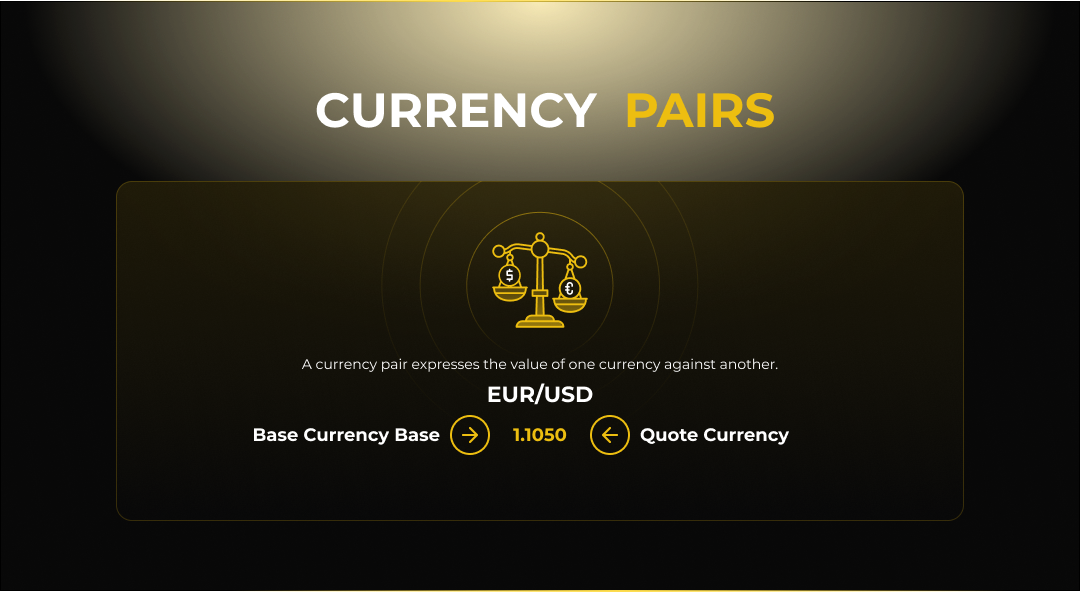
At its core, a currency pair is simply a way of expressing the value of one currency against another.
Example:
EUR/USD = 1.1050 means:
- 1 euro (EUR) = 1.1050 US dollars (USD)
It’s like a “see-saw” – when one side goes up, the other often goes down. You’re never looking at one currency alone; you’re always looking at a relationship between two.
Base Currency & Quote Currency
Every currency pair has two parts:
- Base currency – the first currency in the pair (EUR in EUR/USD)
- Quote currency – the second currency in the pair (USD in EUR/USD)
The price you see tells you how much of the quote currency is needed to buy 1 unit of the base currency.
Example:
- EUR/USD = 1.1050 → You need 1.1050 USD to buy 1 EUR.
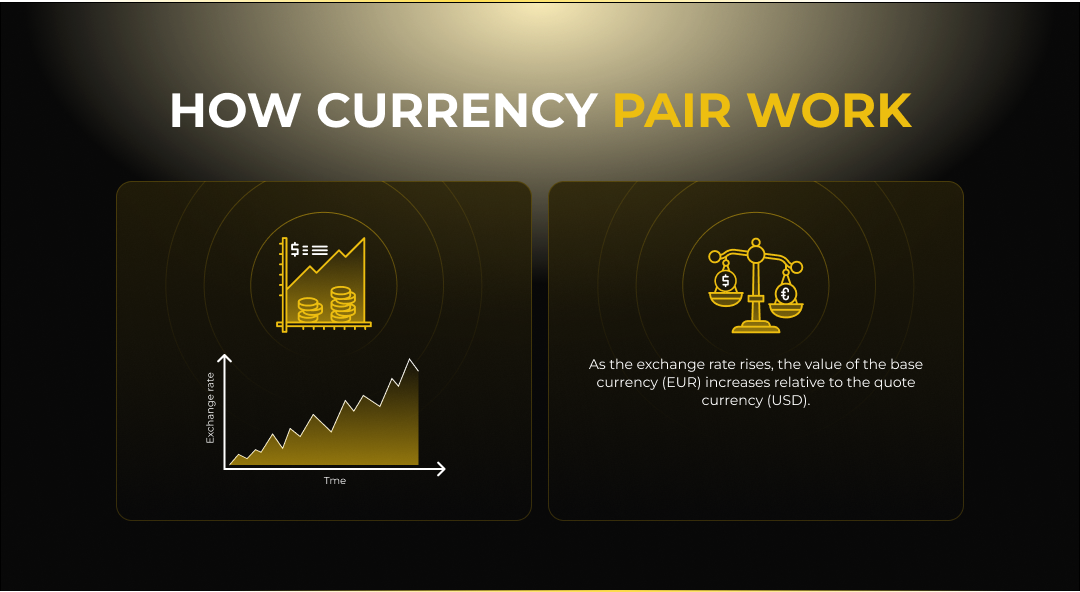
If the price rises to 1.1200, the euro has strengthened, and the dollar has weakened (relative to each other).
The Three Main Types of Pairs
Think of currency pairs as three “families”:
A. Major Pairs
These are the most traded in the world – highly liquid, low spreads.
They always include the US dollar (USD). Examples:
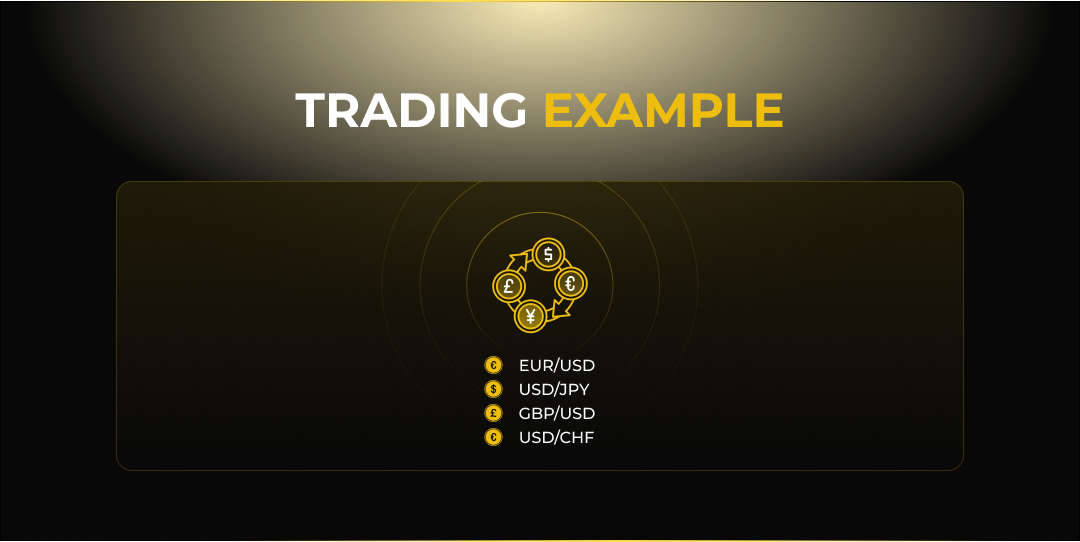
- EUR/USD
- GBP/USD
- USD/JPY
Why trade them? Liquidity means faster execution and smaller transaction costs.
Minor Pairs (Cross Currency Pairs)
These don’t include the US dollar but involve major world currencies. Examples:
- EUR/GBP
- AUD/JPY
- GBP/JPY
Why trade them? They give opportunities without the direct USD factor, often moving due to regional news.
Exotic Pairs
One major currency + one currency from a smaller/emerging economy. Examples:
- USD/TRY (Turkish lira)
- EUR/ZAR (South African rand)
- USD/THB (Thai baht)
Why trade them? Higher volatility = bigger potential moves.
The catch? Wider spreads and less liquidity – they can be “jumpy.”
What Moves Currency Pairs?
The forex market isn’t random – prices move because of:
- Economic Data
Interest rate changes, inflation reports, GDP numbers, employment data – all can send prices flying. - Politics & Geopolitical Events
Elections, wars, trade agreements, sanctions – all shift investor confidence. - Market Sentiment
Risk-on (investors are confident) → money flows into riskier currencies (like AUD, NZD).
Risk-off (investors are fearful) → money flows into safe-havens (like USD, JPY, CHF).
Central Bank Decisions
A single statement from the Federal Reserve or European Central Bank can change a trend instantly.
How Prices Are Quoted – Bid, Ask & Spread
When you open your trading platform, you’ll notice two prices for each pair:
- Bid – The price you sell the base currency.
- Ask – The price you buy the base currency.
The difference is called the spread.
Example:
- EUR/USD Bid = 1.1048
- EUR/USD Ask = 1.1050
Spread = 2 pips (your cost to enter the trade).
Understanding Pips
A pip is the smallest price change in most currency pairs – usually the 4th decimal place.
Example: 1.1050 → 1.1055 = 5 pips.
For JPY pairs, it’s the 2nd decimal place (USD/JPY: 145.50 → 145.55 = 5 pips).
Let’s say you believe the euro will strengthen against the dollar. You buy EUR/USD at 1.1000.
- Price moves to 1.1050 → You gained 50 pips.
- If your position size was 1 standard lot (100,000 units), that’s $500 profit (because 1 pip ≈ $10 for this size in the EUR/USD pair).
If the price went down 50 pips instead – well, that’s $500 loss.
Why Understanding Currency Pairs is Your First Step to Consistent Trading
A lot of beginners jump straight into indicators and strategies without fully grasping the foundation – currency relationships.
But when you understand:
- Which pairs move more during certain sessions
- How economic events impact them
- Which ones fit your style (steady majors or wild exotics)
…you stop guessing and start making informed decisions.
Pro Tips for Mastering Currency Pairs
- Start with majors – learn market behaviour with less volatility before exploring minors and exotics.
- Track correlations – some pairs move together (EUR/USD and GBP/USD), others move opposite (EUR/USD and USD/CHF).
- Respect the spread – avoid trading exotic pairs with huge spreads unless you have a strong reason.
- Follow the news – sometimes it’s not the chart but the calendar that tells you what’s coming.
Final Words
Currency pairs are the DNA of forex trading. Without understanding them, every trade is just a gamble. With understanding, every trade becomes a calculated decision.
So next time you see EUR/USD or GBP/JPY on your screen, you won’t just see numbers – you’ll see a living relationship between economies, politics, and human psychology.
That’s when you stop trading randomly… and start trading like a pro.