
Today we’re going to dive deep into one of the most essential concepts for profitable Forex trading: risk vs. reward. We’ll cover what it means in the context of the Forex market, why it matters, how to use it in your trading plan, and the pitfalls many traders fall into. I’ll keep it simple, friendly and actionable.
Whether you trade the major pairs like EUR/USD, GBP/USD, or more exotic ones, mastering risk vs. reward will help bring discipline and clarity to your decisions.
1. What is Risk vs. Reward in Forex?
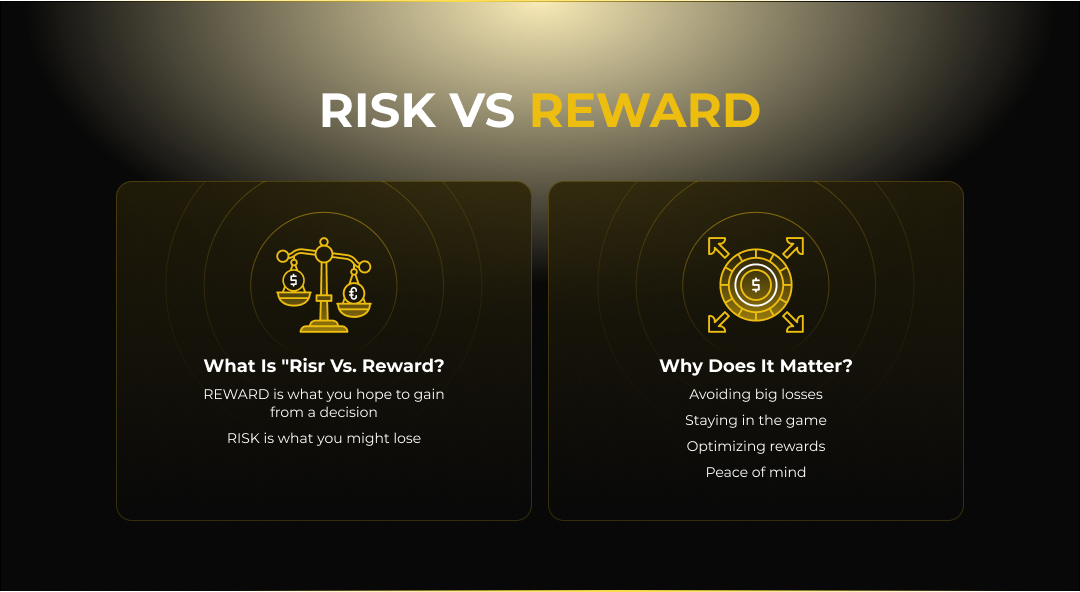
At its core, risk vs. reward is about comparing two sides of a trade:
- Risk: How much you could lose if the trade goes against you.
- Reward: How much you could gain if the trade goes in your favour.
So before you enter a trade, ask yourself: “If I’m wrong, what will I lose?” and “If I’m right, what might I gain?”
In Forex, we often express this in pips (or monetary value) and as a ratio (for example: 1 : 2, meaning you risk 1 unit to gain 2 units).
Example: You buy EUR/USD at 1.1200, you set your stop-loss at 1.1150 (risk = 50 pips). You set your target at 1.1300 (reward = 100 pips). The risk:reward ratio = 50 : 100 = 1 : 2.
When you use this ratio consciously, you’re trading with a plan — not just reacting instinctively.
2. Why Risk vs. Reward Matters in Forex Trading
2.1 Capital preservation
Forex is a fast, liquid market. When you lose big, the losses hurt. When you trade with favourable risk vs. reward, you protect your capital and increase your chances of long-term survival.
2.2 Improves expectancy
Your trading expectancy = (average win × win rate) – (average loss × loss rate). If you have favourable reward potential, you can tolerate a lower win rate and still be profitable. For example, with a 1 : 2 ratio you might win only 40% of your trades and still break even or profit.
2.3 Forces discipline and clarity
By defining risk and reward before entry, you trade with rules. You’re not chasing hope, you’re following a structure. That keeps your emotions in check (fear, greed) and helps you behave like a trader, not a gambler.
2.4 Fits the Forex environment
The Forex market is dynamic: high leverage, 24 / 5 trading, many participants. Without some structure around risk vs. reward, it’s easy to take too much risk, chase small gains, lose big – and burn out.
3. How to Apply Risk vs. Reward in Forex – Step by Step
Here’s how you bring this principle into your Forex trades:
Step A: Determine your stop-loss (risk)
Look at the chart: support/resistance zones, recent swing lows/highs, volatility. Decide where your trade idea would be invalidated. That level becomes your stop-loss. Example: GBP/USD long, your stop-loss is 150 pips below entry.
Step B: Set your target (reward)
Use market structure: trend continuation, breakout levels, Fibonacci extensions, or prior highs/lows. Where does the market have space to move in your favour? Example: target 300 pips above entry.
Step C: Compute the risk:reward ratio
Divide your potential reward by your potential risk. If you risk 150 pips and target 300 pips, ratio = 1 : 2.
Step D: Check your trade plan
Ask yourself: Is 1 : 2 acceptable? Does it fit my account size, trading style, win rate? If not, either adjust (tighten risk, enlarge reward) or skip.
Step E: Execute only if the ratio fits your plan
If you enter a trade with a poor ratio (say 1 : 1 or worse) you need a high win rate to make it worthwhile — and most traders don’t have that consistently. Stick to trades where risk vs. reward makes sense.
Step F: Journal your trades
Record each trade’s risk, reward, ratio, outcome. Over time you’ll see patterns: what ratios you’re achieving, what your actual wins/losses are. That helps you refine your edge.
4. What Makes a “Good” Ratio in Forex?
There’s no perfect number, but some guidelines:
- A common target: risk : reward of 1 : 2 or better. Many professional traders aim for that or higher.
- If your win rate is high (say 60-70 %), you might accept a lower ratio (1 : 1.5).
- If your win rate is low (30-40%), then you’ll need a higher ratio (1 : 3 or more) to compensate.
- The ratio must match your style: Are you a day trader, swing trader, scalper? The timeframe, volatility, currency pair all affect what ratio is realistic.
In Forex, some markets/trades may only offer small reward (tight ranges), others may offer big swings (breakouts). Choose trades where the reward potential is significantly larger than your risk, given what you observe.
5. Real-World Forex Examples
Example 1: Trend breakout on EUR/USD
You spot EUR/USD breaking above a clear resistance at 1.0950. You enter at 1.0960.
Stop-loss: 1.0900 → risk = 60 pips.
Target: 1.1100 → reward = 140 pips.
Ratio = 1 : 2.3. Good trade if your system supports breakouts.
Example 2: Range trade on USD/JPY
Price is bouncing between 134.00 and 134.50. You take a long at 134.05.
Stop-loss: 133.80 → risk = 25 pips.
Target: 134.50 → reward = 45 pips.
Ratio = 1 : 1.8. Acceptable if your trade context supports range, your win rate is good, but less attractive than the breakout example.
Example 3: Poor reward scenario
You see GBP/USD bounce near 1.2500, you buy at 1.2510.
Stop-loss: 1.2460 → risk = 50 pips.
You target 1.2540 → reward = 30 pips.
Ratio = 50 : 30 ≈ 1 : 0.6. That’s weak — you’d need a very high win rate (>>70-80 %) to make it worthwhile. Better to skip or wait for a stronger set-up.
6. Common Pitfalls in Forex Risk vs. Reward
Pitfall A: Ignoring risk altogether
Entering trades without clearly defined stop-loss is a recipe for disaster. In Forex the leverage is high; large losses accumulate fast.
Pitfall B: Favouring risk over reward
Some traders accept bad ratios (1 : 1 or worse) simply because they “feel” the trade will win. Emotion wins over math. Over time this erodes the account.
Pitfall C: Target too large for context
Setting a reward target of 1 : 10 when the pair trades in tight channels and you have no breakout signal is unrealistic. Reward must respect market structure.
Pitfall D: Changing stop-loss or target mid-trade without strategy
Moving your stop further away or moving your target up just because you’re “hopeful” breaks the very discipline risk:reward builds. If your plan allows trailing or scaling, fine — but that must be part of your system.
Pitfall E: Risk per trade too high
Even if you use a good ratio, if you risk 10-20 % (or more) of your account on one trade you become vulnerable to blow-ups. The ratio matters and the size of risk relative to your account.
7. Integrating Risk vs. Reward into Your Forex Trading Plan
Here’s how to bake it into your everyday Forex process:
- Pre-trade checklist: Entry, stop-loss, target, risk:reward ratio, position size (based on your account risk %).
- Position sizing: If you’re risking $100 on a trade (account risk) and your stop-loss is 50 pips, your lot size must reflect that.
- Minimum ratio rule: Set a rule like “I will only take trades with at least 1 : 2 ratio” (or whatever fits your style).
- Journal & review: Track actual risk and reward per trade, ratio achieved, win/loss, whether you followed your plan.
- Adapt: If you find that your trade style often gives only 1 : 1 ratios and you have 50% win rate, maybe adjust to find bigger set-ups or improve win rate.
- Manage risk per trade: Many experienced Forex traders risk only 1-2% of the account per trade. This way even a string of losses won’t destroy you.
8. Final Thoughts: What You Should Remember
Trading Forex is not about hitting a home-run every time. It’s about stacking trades with favourable mathematical expectation, preserving capital, and behaving like a professional. Here are the key take-aways:
- Before every trade, define your risk (stop-loss) and reward (target).
- Calculate the ratio. If it doesn’t meet your plan, skip or adjust.
- Discipline matters: don’t let hope replace your plan.
- Use proper position sizing so that losses don’t derail your account.
- Review your trades: your real data will tell you if your ratio rule is working.
- Adapt your system if you consistently take poor ratios or have weak win rate.
In the world of Forex, where price moves fast, leverage is high, and emotional traps are everywhere, risk vs. reward becomes one of your most powerful defence tools — and also your accelerator when used correctly.