
When you click “Buy” or “Sell” on your trading platform, the order is executed in less than a second. But have you ever stopped to wonder what really happens in the background?
It’s not magic—it’s the combined effort of brokers and liquidity providers (LPs). They are the “invisible hands” that make sure your trades don’t just float in the air but actually get matched, priced, and completed.
Let’s peel back the curtain and see exactly how this works.
The Broker – Your Gateway to the Market
Think of your broker as the “travel agent” of trading. You may want to travel (trade), but without someone to book your tickets, find connections, and guide you through, it would be messy and confusing.
Here’s what brokers actually do for you:
- Give You Market Access
Without a broker’s platform (like MetaTrader, cTrader, TradingView, or proprietary apps), retail traders cannot enter the Forex market directly. The interbank market is closed to individuals—you need a middleman. - Provide the Interface
That slick chart with candlesticks, indicators, and buttons? That’s the broker’s way of giving you access to the huge, chaotic Forex marketplace in a neat, manageable format. - Execute Your Orders
Whether you want to buy EUR/USD or short GBP/JPY, the broker ensures your order is transmitted, matched, and executed as quickly as possible. - Offer Leverage
Brokers often allow you to trade more than your account balance (e.g., 1:100 leverage). This can be powerful, but it’s also risky. - Risk Models – A-Book vs B-Book
- A-Book: The broker sends your trades directly to the liquidity provider. They make money mainly from spreads/commissions.
- B-Book: The broker takes the opposite side of your trade (they profit if you lose). This isn’t necessarily evil, but it does create a potential conflict of interest.
- A-Book: The broker sends your trades directly to the liquidity provider. They make money mainly from spreads/commissions.
As a trader, you want to know what kind of broker you’re dealing with, because their business model influences pricing, execution speed, and even the risk of slippage.
Now, let’s turn to the second hero: Liquidity Providers (LPs).
Imagine a huge water reservoir feeding a city. No matter how many taps open, there’s always water. Liquidity providers are exactly that—but instead of water, they provide buy and sell quotes.
Who Are They?
- Large investment banks (like JPMorgan, Citi, Deutsche Bank).
- Hedge funds and market-making firms (e.g., Citadel Securities, XTX).
- Institutional trading firms that “stand ready” to buy or sell currencies, stocks, or CFDs.
What Do They Do?
- Quote Prices 24/5
They continuously give Bid (buy) and Ask (sell) quotes, so you always see a price on your platform. - Ensure Market Depth
They can absorb large orders without causing huge price swings. This is why a 1-lot trade or a 50-lot trade can both get filled smoothly. - Tighten Spreads
Multiple LPs competing against each other = smaller spreads = lower costs for you. - Reduce Slippage
During big news events, LPs step in to absorb volatility, preventing wild gaps in pricing.
How Brokers & LPs Work Together
Here’s the simple “back-office story” behind your trade:
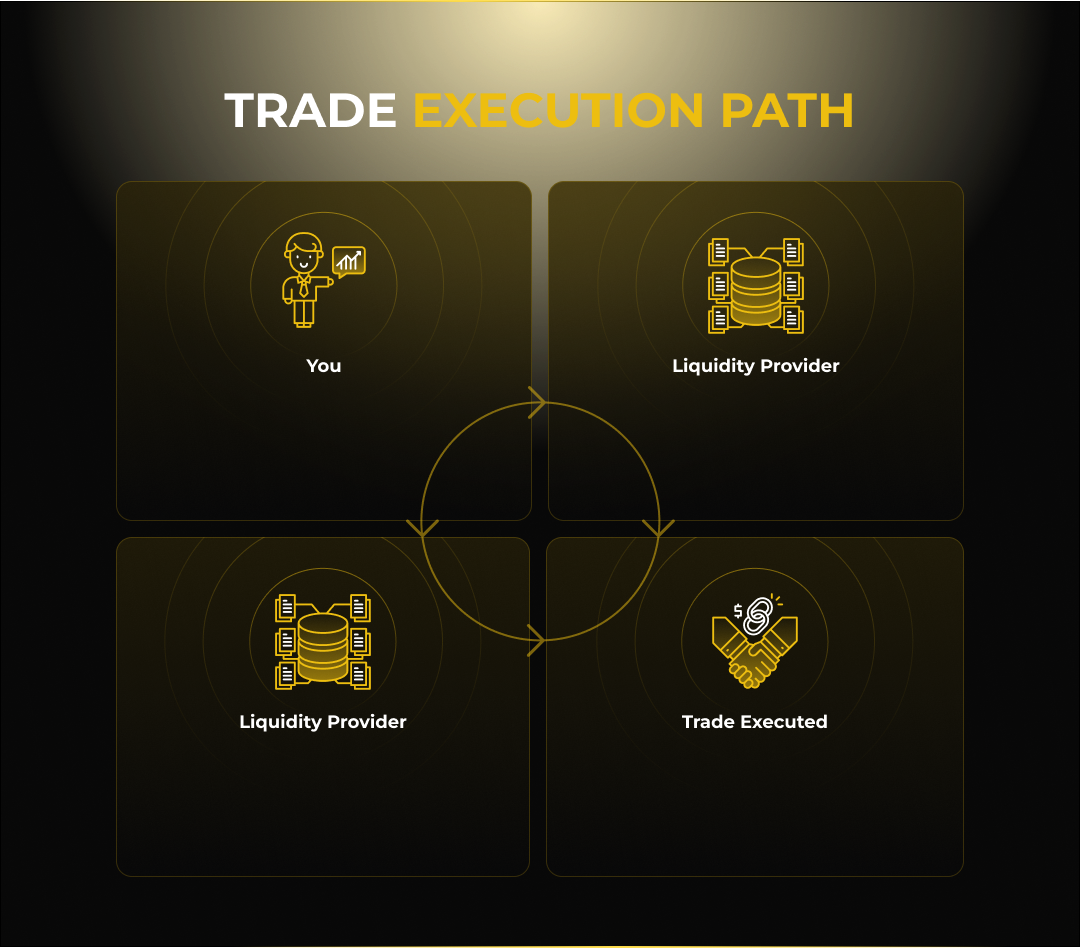
- You click Buy EUR/USD on your broker’s platform.
- The broker instantly looks at its network of liquidity providers.
- The system selects the best price available (lowest ask if buying, highest bid if selling).
- The order is executed—either:
- Directly with an LP (ECN/STP model), or
- Internally matched by the broker (Market Maker/B-Book).
- Directly with an LP (ECN/STP model), or
This process takes milliseconds. But without brokers and LPs, your order might just… sit there unfilled.
Why This Matters for YOU, the Trader
Understanding this relationship is not just “theory”—it has direct impact on your trading results:
- Execution Speed – A good broker + strong LPs = faster order fills. Critical for scalpers and news traders.
- Trading Costs – Tighter spreads and fair commissions mean more profit stays in your pocket.
- Transparency – With ECN/STP brokers, you’re literally trading against the global market—not against your broker.
Safety – Strong LPs mean the market doesn’t “freeze up,” even during volatility (think NFP or central bank decisions).
Common Misconceptions Traders Have
“My broker is always against me.”
Not true. Many brokers operate on an A-Book model where they don’t benefit from your losses.
“Liquidity providers are invisible, so they don’t matter.”
In truth, LPs directly impact your spreads, slippage, and even the quality of chart prices you see.
“All brokers are the same.”
No—choosing a regulated broker with strong LP connections can be the difference between a smooth trading career and endless frustration.
Practical Tips for Traders
- Check Regulation – A licensed broker is more likely to work with top-tier LPs.
- Look at Spreads – Consistently tight spreads are a sign of strong LP backing.
- Test Execution – Use a demo/live small account to see how fast orders are filled.
- Ask About Business Model – Don’t be shy to ask your broker if they run A-Book, B-Book, or hybrid.
Beware of “Too Good to Be True” Offers – Unrealistic leverage or zero spreads often hide shady setups.
Final Thoughts
In the Forex world, brokers and liquidity providers are like the stage crew in a theater. You, the trader, are the actor. The audience (the market) only sees your performance, but without the backstage crew—lights, sound, props—your performance would collapse.
By understanding their role, you not only gain confidence but also make smarter choices when selecting a broker. And in trading, the right choice of broker + liquidity providers can be as important as your strategy itself.